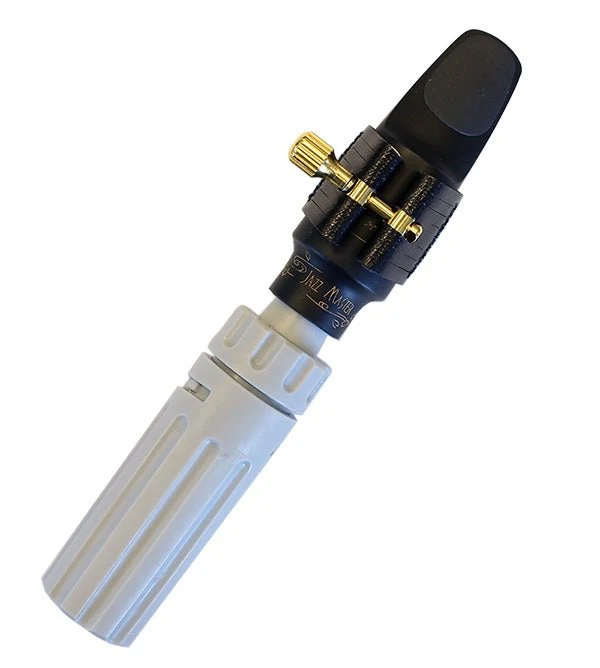
Mouthpiece Silencer
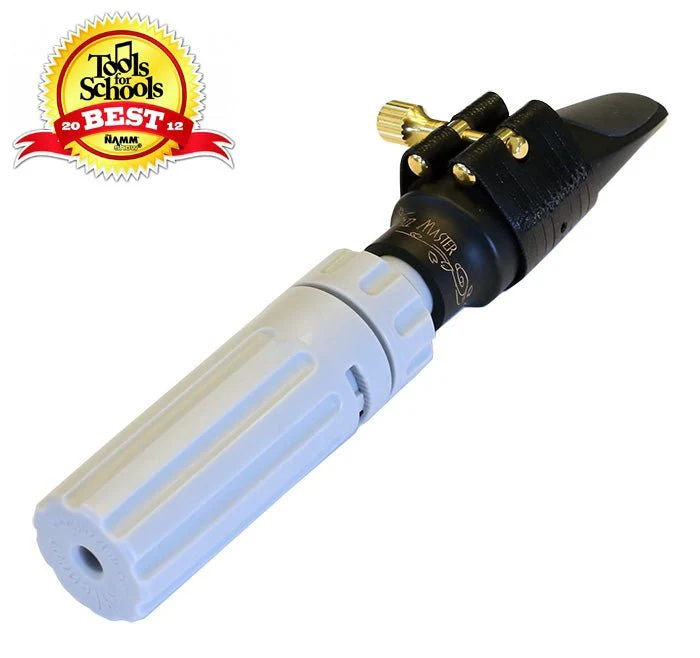
A re-designed silencer for clarinet, soprano, alto, tenor and baritone saxophones.
All attachments supplied in one box.
Mouthpiece exercises for woodwind instruments are one of the best methods to continually improve your sound. Embouchure, breathing and articulation can all be optimally trained.
In practice, however, there is one disadvantage: the sound of the mouthpiece is loud and piercing - so conflicts with the neighbours can be an issue. A silencer is an excellent solution: it considerably reduces your sound level, meaning you can practice anywhere at any time.
Many people are surprised when they realise you can produce tones and whole melodies with just the mouthpiece of a saxophone or a clarinet. The variety of sound produced depends entirely on the person practicing.
Mouthpiece exercises
These findings prompted Joe Allard, the grand master of woodwinds, to develop a new method of training and suitable exercises, among which are mouthpiece exercises. With these exercises Joe Allard documented astonishing results whilst investing comparatively little expenditure of time. Among his students were saxophonists as David Liebman, Michael Brecker, Stan Getz, Bob Berg and Glenn Miller’s entire sax section.
Continuous improvement of sound
Mouthpiece exercises for woodwinds are one of the best methods to continually improve your sound. Furthermore, one can train the embouchure, breathing and articulation simultaneously. Daily exercises – 5 minutes a day are enough – are the key to a higher level of sound and intonation on the instrument. Through mouthpiece exercises you train exactly those areas that are crucial to the playing of a saxophone or a clarinet: sound, intonation, special effects such as vibrato or bending, and high tones.
Avoiding conflicts
One can take a mouthpiece and practice on it nearly anywhere, whether on a train, in a car (with the motor turned off of course) or in a hotel room. But there is one serious problem with this: the tone produced by a mouthpiece is approximately 100 dB and therefore trouble with passengers or hotel guests, as well as neighbours, is nearly inevitable!
Wilhelm Busch said: “Music is often found to be disturbing because it is connected to noise.” What is loud music for one person is actually noise for another. Whoever plays an instrument has to practice; and sometimes for the neighbours this practice can be disturbing noise!
Here the silencer can produce relief, and allow quieter practices that don’t disturb the neighbours. A silencer attached to your mouthpiece will reduce volume significantly, by a good 14 to 20 decibels. This allows you to practice very quietly at any time – whether night or day – and in just about any place!
Care of your silencer
The silencer is made of high quality plastic, which is easy to clean. To maintain it for optimal use all three parts must be assembled correctly and cleaned after every use.
If you own multiple silencers for multiple instruments, please be aware that the coupling pieces are different sizes. The cases are identified for the coupling pieces (for example with “TENOR SAX” or “ALTO SAX”); only the right insertion end fits into the cap.
It’s easy to assemble the silencer: insert the muffler with a slight rotating movement into the mouthpiece. To use with a clarinet mouthpiece, some cork-grease may be required.
To disassemble, remove the silencer from your mouthpiece, with a slightly rotating movement.
Now you can easily screw off the silencer-cap and separate it from the insertion point. For hygienic reasons we recommend cleaning the silencer under water after each usage. Do not use caustic cleaning agents. From time to time you can put the separate parts into a glass of vinegar for one hour and then wash them with water, to remove any calcium deposits.
After drying the parts, stick the insertion into the cap and then screw the cap onto the case.
More Images
Mouthpiece Silencer
A re-designed silencer for clarinet, soprano, alto, tenor and baritone saxophones.
All attachments supplied in one box.
Mouthpiece exercises for woodwind instruments are one of the best methods to continually improve your sound. Embouchure, breathing and articulation can all be optimally trained.
In practice, however, there is one disadvantage: the sound of the mouthpiece is loud and piercing - so conflicts with the neighbours can be an issue. A silencer is an excellent solution: it considerably reduces your sound level, meaning you can practice anywhere at any time.
Many people are surprised when they realise you can produce tones and whole melodies with just the mouthpiece of a saxophone or a clarinet. The variety of sound produced depends entirely on the person practicing.
Mouthpiece exercises
These findings prompted Joe Allard, the grand master of woodwinds, to develop a new method of training and suitable exercises, among which are mouthpiece exercises. With these exercises Joe Allard documented astonishing results whilst investing comparatively little expenditure of time. Among his students were saxophonists as David Liebman, Michael Brecker, Stan Getz, Bob Berg and Glenn Miller’s entire sax section.
Continuous improvement of sound
Mouthpiece exercises for woodwinds are one of the best methods to continually improve your sound. Furthermore, one can train the embouchure, breathing and articulation simultaneously. Daily exercises – 5 minutes a day are enough – are the key to a higher level of sound and intonation on the instrument. Through mouthpiece exercises you train exactly those areas that are crucial to the playing of a saxophone or a clarinet: sound, intonation, special effects such as vibrato or bending, and high tones.
Avoiding conflicts
One can take a mouthpiece and practice on it nearly anywhere, whether on a train, in a car (with the motor turned off of course) or in a hotel room. But there is one serious problem with this: the tone produced by a mouthpiece is approximately 100 dB and therefore trouble with passengers or hotel guests, as well as neighbours, is nearly inevitable!
Wilhelm Busch said: “Music is often found to be disturbing because it is connected to noise.” What is loud music for one person is actually noise for another. Whoever plays an instrument has to practice; and sometimes for the neighbours this practice can be disturbing noise!
Here the silencer can produce relief, and allow quieter practices that don’t disturb the neighbours. A silencer attached to your mouthpiece will reduce volume significantly, by a good 14 to 20 decibels. This allows you to practice very quietly at any time – whether night or day – and in just about any place!
Care of your silencer
The silencer is made of high quality plastic, which is easy to clean. To maintain it for optimal use all three parts must be assembled correctly and cleaned after every use.
If you own multiple silencers for multiple instruments, please be aware that the coupling pieces are different sizes. The cases are identified for the coupling pieces (for example with “TENOR SAX” or “ALTO SAX”); only the right insertion end fits into the cap.
It’s easy to assemble the silencer: insert the muffler with a slight rotating movement into the mouthpiece. To use with a clarinet mouthpiece, some cork-grease may be required.
To disassemble, remove the silencer from your mouthpiece, with a slightly rotating movement.
Now you can easily screw off the silencer-cap and separate it from the insertion point. For hygienic reasons we recommend cleaning the silencer under water after each usage. Do not use caustic cleaning agents. From time to time you can put the separate parts into a glass of vinegar for one hour and then wash them with water, to remove any calcium deposits.
After drying the parts, stick the insertion into the cap and then screw the cap onto the case.
Product Information
Product Information
Shipping & Returns
Shipping & Returns
Description
A re-designed silencer for clarinet, soprano, alto, tenor and baritone saxophones.
All attachments supplied in one box.
Mouthpiece exercises for woodwind instruments are one of the best methods to continually improve your sound. Embouchure, breathing and articulation can all be optimally trained.
In practice, however, there is one disadvantage: the sound of the mouthpiece is loud and piercing - so conflicts with the neighbours can be an issue. A silencer is an excellent solution: it considerably reduces your sound level, meaning you can practice anywhere at any time.
Many people are surprised when they realise you can produce tones and whole melodies with just the mouthpiece of a saxophone or a clarinet. The variety of sound produced depends entirely on the person practicing.
Mouthpiece exercises
These findings prompted Joe Allard, the grand master of woodwinds, to develop a new method of training and suitable exercises, among which are mouthpiece exercises. With these exercises Joe Allard documented astonishing results whilst investing comparatively little expenditure of time. Among his students were saxophonists as David Liebman, Michael Brecker, Stan Getz, Bob Berg and Glenn Miller’s entire sax section.
Continuous improvement of sound
Mouthpiece exercises for woodwinds are one of the best methods to continually improve your sound. Furthermore, one can train the embouchure, breathing and articulation simultaneously. Daily exercises – 5 minutes a day are enough – are the key to a higher level of sound and intonation on the instrument. Through mouthpiece exercises you train exactly those areas that are crucial to the playing of a saxophone or a clarinet: sound, intonation, special effects such as vibrato or bending, and high tones.
Avoiding conflicts
One can take a mouthpiece and practice on it nearly anywhere, whether on a train, in a car (with the motor turned off of course) or in a hotel room. But there is one serious problem with this: the tone produced by a mouthpiece is approximately 100 dB and therefore trouble with passengers or hotel guests, as well as neighbours, is nearly inevitable!
Wilhelm Busch said: “Music is often found to be disturbing because it is connected to noise.” What is loud music for one person is actually noise for another. Whoever plays an instrument has to practice; and sometimes for the neighbours this practice can be disturbing noise!
Here the silencer can produce relief, and allow quieter practices that don’t disturb the neighbours. A silencer attached to your mouthpiece will reduce volume significantly, by a good 14 to 20 decibels. This allows you to practice very quietly at any time – whether night or day – and in just about any place!
Care of your silencer
The silencer is made of high quality plastic, which is easy to clean. To maintain it for optimal use all three parts must be assembled correctly and cleaned after every use.
If you own multiple silencers for multiple instruments, please be aware that the coupling pieces are different sizes. The cases are identified for the coupling pieces (for example with “TENOR SAX” or “ALTO SAX”); only the right insertion end fits into the cap.
It’s easy to assemble the silencer: insert the muffler with a slight rotating movement into the mouthpiece. To use with a clarinet mouthpiece, some cork-grease may be required.
To disassemble, remove the silencer from your mouthpiece, with a slightly rotating movement.
Now you can easily screw off the silencer-cap and separate it from the insertion point. For hygienic reasons we recommend cleaning the silencer under water after each usage. Do not use caustic cleaning agents. From time to time you can put the separate parts into a glass of vinegar for one hour and then wash them with water, to remove any calcium deposits.
After drying the parts, stick the insertion into the cap and then screw the cap onto the case.